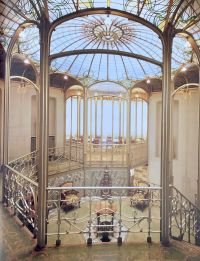
Osvald Polívka (1859 – 1931) was an Austrian Empire-born architect associated with the Art Nouveau period in Prague. Polívka designed many of Prague’s significant landmarks of the era, plus other work in Brno and elsewhere.
Antonín Balšánek (1865 – 1921) was born into the family of master carpenter Vojtěch Balšánek. He worked in the Neo-Renaissance style, which, however, he combined with Art Nouveau elements , especially in detail.
Polívka and Balšánek can jointly represent the Czech Art Nouveau movement.
They managed the construction of the Municipal House (Obecní dům) in Prague (1905–1911).
The Municipal House
In 1902 the City Council approved the construction and in 1903 it approved the purchase of land next to the Powder Gate. In 1904 the project was approved and construction works began in 1905. The building was built from 1905 to 1911 according to the project of architect Antonín Balšánek and Osvald Polívka as a centre of the Czech cultural life. The building comprises several bars and restaurants together with exhibition space and the elegant Smetana auditorium.


The main auditorium at the Prague Municipal House is Smetana Hall, a prominent and celebrated Art Nouveau concert venue known for its beautiful design and superior acoustics, which host various classical music performances and other cultural events.
For the full story of The Municipal House click on the link below:
The story of the Municipal House (O becni dum)
Further Reading