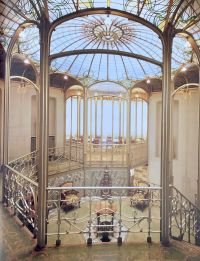
Hankar was born at Frameries, in Hainaut, Belgium, the son of a stonemason. He studied at the Royal Academy of Fine Arts in Brussels, where he met fellow student (and future architect) Victor Horta. Like Horta, he closely studied the techniques of forged iron, which he would later use in many of his buildings. He began his career as a designer and sculptor of funeral monuments. Hankar became an admirer of Eugène Viollet-le-Duc, the French architect who advocated the use of innovative new materials such as iron and glass, while drawing from historical architecture for inspiration.


He opened his own office in Brussels in 1893, and began construction of his own house, the Hankar House, at 71, rue Defacqz, in the Saint-Gilles municipality of Brussels. This and Victor Horta’s Hôtel Tassel (constructed at the same time), are considered the first two houses built in the Art Nouveau style.
Hotel Hankar


Atelier Ciamberlani


Doors and windows
A feature of Hankar’s work is the almost obsessive interest in the design of glazed doors and windows. His sketch books are full of designs incorporating elaborate glazing bars. Most of his buildings incorporate interesting doors and windows.


Hankar and Horta
The first Art Nouveau houses of Hankar and Horta were completed in the same year, 1893, and the styles of the two architects were similar in several ways. They both renounced traditional historical styles, made visible use of new materials, such as glass and iron, and had as well a strong preference for arches, and for curving lines, a style sometimes called à membrures, which characterised the early work of both architects. There was a great difference, however, in their available budgets; Hankar was building homes for his artist friends, with modest budgets, while Horta had very wealthy patrons, who could afford the most expensive materials and larger houses. The chief feature of Horta’s houses was the interior, while the focus of Hankar’s houses was primarily the facade. Hankar believed that Horta’s work was excessively lavish; he called it “Louis XV”.