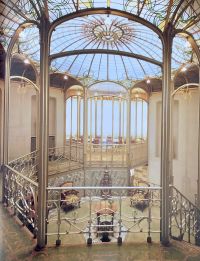


Otto Koloman Wagner (1841 – 1918) was an Austrian architect, furniture designer and urban planner. He was a leading member of the Vienna Secession movement of architecture, founded in 1897, and the broader Art Nouveau movement. Many of his works are found in his native city of Vienna, and illustrate the rapid evolution of architecture during the period. His early works were inspired by classical architecture. By mid-1890s, he had already designed several buildings in what became known as the Vienna Secession style. Beginning in 1898, with his designs of Vienna Metro stations, his style became floral and Art Nouveau, with decoration by Koloman Moser. The Stadtbahn (Metropolitan Railway) stations were designed and built by Wagner between 1894 and 1901. Each one was individually designed to fit into the cityscape surrounding them. The most famous is Karlsplatz pictured above and below.

The Schützenhaus 1904

The Schützenhaus was built in 1904 – 1908 according to plans by Otto Wagner. It iwas effectively a service building for the Danube Canal which runs past in front.The building was part of a planned weir. Schützenhaus refers to the control gates (Schütze) used in such weirs. Today, the building houses a restaurant called “Otto Wagner Schützenhaus”.
Postal Savings Bank, Vienna, 1904-06


Majolikahaus (Majolica House) 1898


The Majolica tiles were a part of Otto Wagner’s grand vision. He believed that hygiene was an important part of modern architecture. These Maiolica tiles are not only weather-resistant, but they are also low maintenance, and washable. Majolica, can refer to a certain type of colourfully painted tin-glazed pottery from the 15th and 16th century. It also can refer to many other types of glazed pottery.
Villa Wagner 1 1888


Built as a summerhouse, the plans for Villa Wagner I, which included a bowling alley in the garden, an opulent external staircase, and an orangery, were first exhibited in Berlin.
The house became the site of events welcoming many of Wagner’s famous friends from the Austrian art scenes. Gustav Klimt, Josef Hoffmann, Gustav Mahler, and other famous names from the Vienna Secession movement spent time inside the villa’s walls. Unfortunately, after this period, the site was taken over by the Nazis during World War II, and the estate entered a period of decline. It was even considered for demolition around the 1960s.
Despite it falling into some disrepair, Austrian painter Ernst Fuchs purchased the site in 1972. He spent two years renovating the site before opening it to the public. Today, the villa is home to the Ernst Fuchs Museum, and visitors can explore two floors of custom-made furniture and artwork, including large-scale paintings, customized fabrics, and erotic bronze statues. An outstanding fountain house, a small gallery, and a cafe with an extravagantly styled esplanade combine to make the entire estate a tribute to Fantastic Realism.
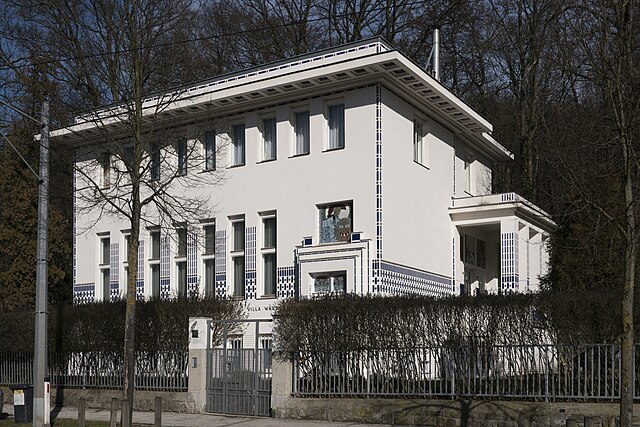
Villa Wagner II

Further reading about Otto Wagner