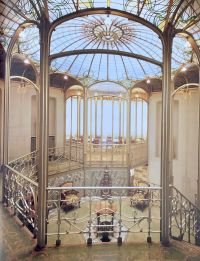
The period between the ‘Compromise’ of 1867 and World War One was the most prosperous era of Hungarian culture. In 1896 the country celebrated 1000 years of the Hungarian nation. It was time for Art Nouveau architecture.

Royal Postal Savings Bank, Ödön Lechner 1901
Ödön Lechner. 1845-1914
Ödön Lechner was one of the prime representatives of the Hungarian Szecesszió style, Art Nouveau. He is famous for decorating his buildings with Zsolnay tile patterns inspired by old Magyar and Turkic folk art. As was the case with other Art Nouveau architects of the period he introduced the use of exposed wrought ironwork into his buildings.
Institute of Geology. 1899.


Royal Postal Savings Bank. 1901


Zsolnay Tiles
A Hungarian specialist tile manufacturer
Pyrogranite refers to a type of ornamental ceramics that were developed by Zsolnay and placed in production by 1886. Fired at high temperature, this durable material remains acid and frost-resistant making it suitable for use as roof tiles, indoor and outdoor decorative ceramics, and fireplaces.
Shown here on the roof of the Museum of Applied Arts building in Budapest