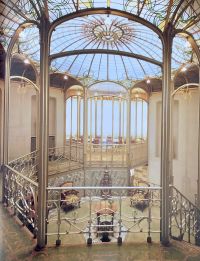
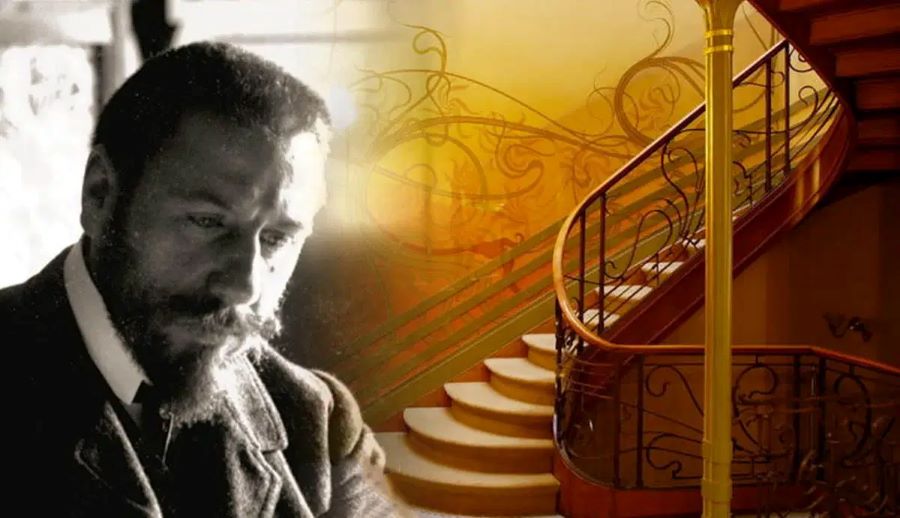
Victor Pierre Horta (1861 – 1947) was a Belgian architect and designer, and one of the founders of the Art Nouveau movement. He was a fervent admirer of the French architectural theorist Eugène Viollet-le-Duc and his Hôtel Tassel in Brussels (1892–93), is often considered the first Art Nouveau house. He is also considered a precursor of modern architecture for his open floor plans and his innovative use of iron, steel and glass.The curving stylized vegetal forms that Horta used in turn influenced many others, including the French architect Hector Guimard, who used it in the first Art Nouveau apartment building he designed in Paris and in the entrances he designed for the Paris Metro. With a decade of the building of Hotel Tassel, Art Nouveau architecture had been realised throughout the cities of Europe and far flung locations such as Buenos Aires. At this time Argentina was the fourth wealthiest country in the world. The association of great wealth and Art Nouveau buildings is not a coincidence.
All of Victor Horta’s works in his Art Nouveau period, ten years from 1893, were built seemingly regardless of cost. His construction and design were both radical, innovative and very expensive. His clientele were exclusively the haute-bourgeoisie.
Most other Art Nouveau houses have a more conventional construction with an Art Nouveau styled facade.


Along with many other Art Nouveau architects he could be regarded not as just an architect but more as an all around designer who designed lighting, furniture and decoration. Everything.

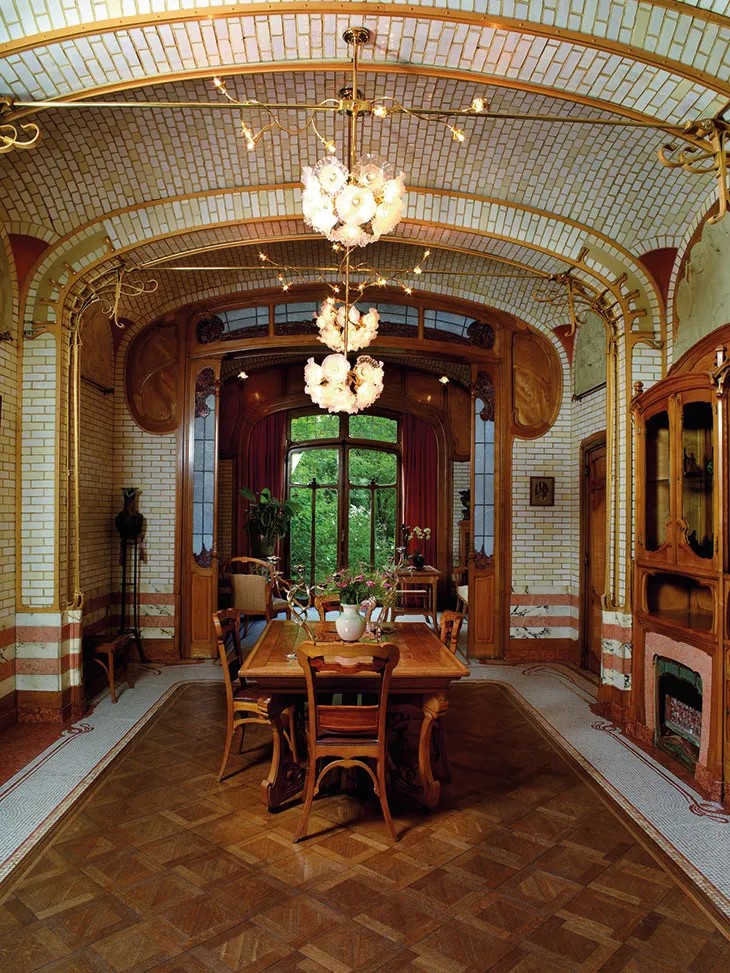
Horta’s career was long and distinguished but the period in which he designed his most important Art Nouveau works was brief, essentially 1883 until 1903. During the 1880s his work was broadly Beaux Arts in inspiration, typified by the Edicule Lambeaux, an exquisite little classical pavilion he designed in 1890 for the Parc du Cinquantenaire in Brussels. The Maison Autrique, built in 1893, was innovative in the way it introduced riveted ironwork into a domestic interior, but it was the Hôtel Tassel (designed 1892–93) that marked a decisive stylistic and spatial departure. This work was Horta’s first fully realised art nouveau design, a remarkable and revolutionary new architectural style.

Horta’s achievements were largely confined to houses for Brussels’ wealthy bourgeoisie. The Maison du Peuple was one of the very few public buildings he completed during his art nouveau period and was, inexplicably, demolished in the mid 1960s. Commissioned by the Société Coopérative Ouvrière de Bruxelles, it provided public space for gatherings and political discussion as well as musical and theatrical performances.
After 1900, Horta’s work grew in scale but reduced in ambition. He had less opportunity for his creativity. His urban planning and smaller-scale schemes for rural housing became more traditional and familiar in both language and intent. The dream-like interiors of his art nouveau houses were gone.
The Buildings
Those marked * no longer exist.
Those marked ** are UNESCO listed
Blue links offer further information
Hotel Deprez 1896
Hotel Aubecq 1899*
Maison et Atelier Horta 1898**
Villa Carpentier 1903
Les Grand Magasins 1901
Le Grand Bazar Anspach 1903*
Le Maison de Sander Pierron 1903
Les Magasins Wolfers 1897
Hospital Brugman 1923
Expo Pavillion 1925*
Le Palais des Beau-Arts 1922
Visits to some of Victor Horta’s houses are often possible. Check the link below.
For further reading covering all of Victor Horta’s work please see